
The Provocative Reality Behind the Cuban Airplane Shootdown

I was in Cuba last year for a time for a peace conference, but I wrote little about it since I was recovering from my concussion courtesy of the State Department. Part of the reason I went was to learn about US biowarfare against Cuba, stay tuned.
They happened to be having a beautiful art biennial in Havana and one gallery offered a sketch pad, which I did this with — playing with the similarities between the Cuban and Palestinian flags and hands coming together:
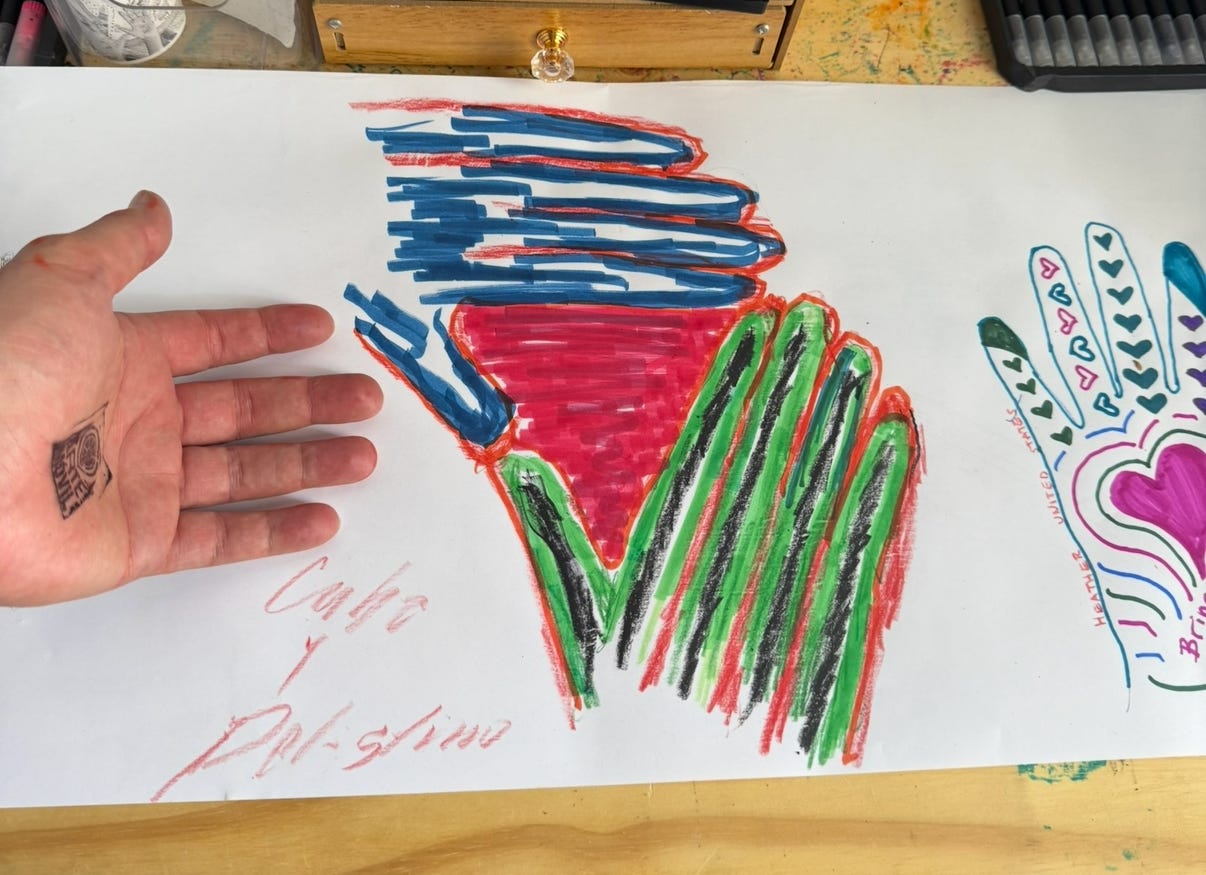
I just drafted the news release below for accuracy.org. Peter Kornbluh lays out a great case. One of the things he notes is how Bill Richardson’s deceitful actions effectively facilitated the 1996 shootdown which is now being used as a pretext to further threaten Cuba.
The cherry on top is that the following year, Clinton made Richardson UN Ambassador, which tells you how people get ahead in the US establishment. I tangled with him on Iraq sanctions — which he worked to keep in place to starve the Iraqi people.
The only part of the Kornbluh statement that I disagreed with (and didn’t include in the IPA news release) is likening what happened with the shootdown to a “Greek tragedy”. As I understand it, classical Greek tragedies are usually about fate than about insidious plots, which seems to be the case here.
In my questioning of Oliver Stone last year “Oliver Stone Questioned About Israeli Spy Executive Producing His ‘JFK’ Film” — I noted that Israel got their nukes but the rightwing Cubans never got their Cuban regime change. They may get it now, and kiss the imperial Israeli ring in gratitude for their crime in helping pave the way. I’ve written that “Palestine Will Free Us All” — and just as surely imperial Israel tries to enslave us all.
Few recall that the US government actually made overtures to Cuba regarding voting for the invasion of Iraq in 1990. They would vote against UNSC Resolution 678 — Yemen was the only other UNSC member to do so.
I also drafted this accuracy.org release featuring James Early on Monday.
The Provocative Reality Behind the Cuban Airplane Shootdown -- Interviews Available
The U.S. government on Wednesday indicted 94-year-old Raúl Castro, charging the former Cuban president in connection with the downing of two planes carrying “Brothers to the Rescue,” an anti-government group in exile, killing four, back in 1996.
PETER KORNBLUH, peter.kornbluh@gmail.com
Available for a limited number of interviews, Kornbluh is co-author with William M. LeoGrande of Back Channel to Cuba: The Hidden History of Negotiations Between Washington and Havana. He is also director of the Cuba and Chile Documentation Projects at the National Security Archives.
On Tuesday, the group posted “Cuba: Declassified Records on the Brothers to the Rescue Shootdown,” which states: “One month before Cuban MiG aircraft shot down two unarmed Cessna planes off the island coast, a Federal Aviation Administration (FAA) official cited ‘further taunting of the Cuban Government’ by the Brothers to the Rescue (BTTR) overflights and State Department concern about a ‘worst case scenario’ in which ‘one of these days the Cubans will shoot down one of these planes and the FAA better have all its ducks in a row.’ The declassified FAA email is one of several records on the shootdown published today by the National Security Archive.
“FAA emails, memos, and communications recorded concerns among high-level Clinton administration officials that repeated penetrations of Cuban airspace would eventually lead to a crisis if Cuba acted to protect its territorial integrity from provocative BTTR incursions. ‘A major fear is the possible downing of a BTTR aircraft by land-based gunfire,’ a summary of an August 1995 meeting with White House officials stated.
“The posting comes as the U.S. Department of Justice prepares to indict Cuban leader Raul Castro for his role in the downing of the BTTR planes. At the time, General Castro served as minister of defense and was the highest officer in the military chain of command in Fidel Castro’s government. The documents offer a detailed historical context in which the aerial violence against the civilian aircraft occurred.
“The FAA records also provide significant details on events leading up to the February 24, 1996, downing of the planes, which cost the lives of four Cuban American members of BTTR. Among those details:
* Starting a year before the shootdown, the Cuban government filed multiple protests on repeated violations of its airspace by BTTR aircraft overflying populated zones and dropping thousands of leaflets and other materials calling for popular insurrection against the government.
* The FAA opened a protracted investigation, met with BTTR president Jose Basulto, and warned him multiple times not to continue his ‘taunting’ provocations. The agency took steps to suspend his pilot’s license but allowed him to keep flying, even as he repeatedly filed false flight plans.
* High-level U.S. officials, including White House Cuba point man Richard Nuccio, State Department undersecretary Peter Tarnoff, and Secretary of Transportation Federico Peña repeatedly expressed their concerns to the FAA that BTTR flights should be permanently grounded and repeatedly warned that Cuba’s redlines to protect its security should be taken seriously. Their efforts to press the FAA to clip Basulto’s wings failed. Only after the shootdown did the FAA issue a concrete ‘cease and desist’ order against Basulto for what it called ‘careless or reckless’ operations that ‘endanger the lives or property of others.’
“The FAA documents were obtained through the Freedom of Information Act (FOIA) for the 2014 book, Back Channel to Cuba: The Hidden History of Negotiations Between Washington and Havana, by American University Cuba specialist William LeoGrande and Archive senior analyst Peter Kornbluh. The book detailed multiple backchannel attempts by Cuban leaders, including Fidel Castro, to press the Clinton administration to halt the provocative BTTR flights. In January 1996, Castro personally struck a secret deal with then Congressman Bill Richardson to release several political prisoners in return for an ironclad promise from President Clinton to ground Basulto’s planes. Although Richardson told Castro he had obtained that commitment from the President, in reality he had talked to other White House aides who had then appealed to Secretary Peña to intercede with the FAA.
“On the night of February 23, according to Back Channel to Cuba, the White House official in charge of Cuba, Richard Nuccio, sent an email to National Security Advisor Sandy Berger alerting him that Basulto intended to fly the next day. ‘Previous overflights by Jose Basulto of the Brothers have been met with restraint by Cuban authorities,’ he reported. ‘Tensions are sufficiently high within Cuba, however, that we fear this may finally tip the Cubans toward an attempt to shoot down or force down the plane,’ he warned.
“Nuccio called FAA officials in Miami and instructed them to block the flights. To his surprise, they refused. The FAA agreed only to warn Basulto, again, against violating Cuban airspace.”
On October 6, 1976 Luis Posada Carrilles, an anti Castro Cuban CIA asset placed a bomb on a Cuban airliner when it was in Barbados. He got off the plane before the bomb exploded killing everyone on board including the Cuban fencing team on their way to a fencing match.
I have been to Cuba three times. The first was in 1999 when I went with the group Pastors For Peace,. We left McAllen, Texas and drove to Tampico, Mexico with tons of humanitarian aid. When we got to Tampico the mayor put on a fiesta for us. In Tampico the aid was loaded onto ship heading to Cuba. The rest of us flew on a Cuban airliner to Havana. While in Tampico I called my son who told me that I had received a letter from the Clinton administration saying that I could be fined $51,000 for going to Cuba. I wasn't fined. The Americans knew I was going. All of us had to get a letter saying we are journalists. The year before I had been to Nicaragua and written an article for my local newspaper so one of the editors had no problem writing me a letter. I told him that I also needed a letter for my husband who was coming with me. He asked me what he does. I told him that he is a graphic artist and a very good photographer. He wrote a letter saying that he is a fine photographer whose work is well known to me. When we got home I wrote an article for the newspaper and gave my husband the credit, It was an act of love. He wasn't an American citizen at the time and had a Green card. He was from New Zealand. He later became a dual citizen.
While in Havana the women stayed in a section of the orthopedic hospital that had been set aside for relatives of patients whose families lived outside of Havana. One day one of my friends and I went into a museum filled with the evidence of the terrorism the United States had unleashed on Cuba for years. While we were in Havana there was a huge religious revival. Fidel was there. That night we were told to dress nicely as we were going to meet someone very important. That was Fidel. He shook hands with all of us. He spent more time with the few young women in our group and with the internationals in our group who faced no hostility from their governments than we Americans did. After I shook hands with him I thought it was so ironic because in 1960 I shook the hand of the man who tried to kill him, John Fitzgerald Kennedy.
My next two trips were when my husband and I rented a car and drove through much of Cuba usually staying in a casa particular. and on occasion in a hotel. What bothered us was that the people at the front desk who greeted guests were always light skinned Cubans with maids and others of a lower status having darker skins.
FAA refused. What an indictment. Thanks much.